Categories
Association Blog Charters Changing Lives

Gala’s Story

How an East Valley Charter School Inspired One Student to Think Globally

Gala Palavicini arrived in the United States last year hoping to learn how to navigate the college application process so she could attend school in this country.

Although she took important steps towards achieving that goal, her most important lesson occurred while she was enrolled as a high school senior at Paragon Academy, a K-12 public charter school in Chandler.

As a resident of Chandler, a Phoenix suburb, with an international background, Palavicini, 19, was a perfect fit for the school, which has a student body representing more than 15 different countries, including France, Sudan and El Salvador.

However, the school’s diverse population didn’t just allow her to feel more comfortable; it taught her that all students are connected regardless of background or country of origin.

“I never quite understood that there’s a whole world out there that we should learn about,” said Palavicini, who graduated from Paragon in May and still volunteers at the school a couple of times per week. “The good thing about Paragon is we have people from all over the world.”

EXCELLENCE IN THE PHOENIX URBAN CORE

By Eileen Sigmund and Lisa Graham Keegan

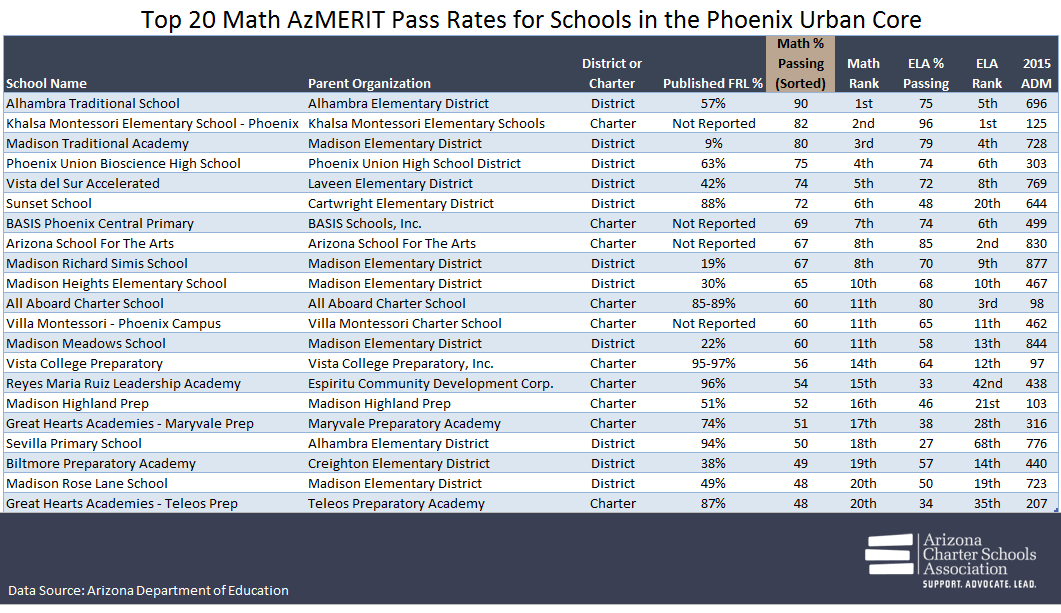
Newly released AzMERIT data show a spectacular picture of what excellence — and emerging excellence — looks like.

Take the Phoenix urban core as an example. There are 219 schools serving nearly 130,000 students. When looking at the top 20 public schools that performed the best in math, we see two REALLY important things: half are district schools and half are charter schools. And most importantly – please set down your coffee and focus – HALF of the schools serve a majority of low-income students, and half serve a higher wealth population.

What this says to us is that excellent school performance is first and foremost a function of the people inside a school who make a decision about what they expect from themselves and their students every day.

Both district and charter schools are offering this level of “great”, and schools serving low-income students are often outperforming much higher wealth schools. The job for parents is to know who is offering quality and to access that for their children. The job for the rest of us is to play whatever role we have in order to get the schools under our influence or in our communities up to these same higher quality levels.

Nothing about this chart of achievement says that we are done – there is plenty of room to grow, and the schools on this list will be the first to say so. But let’s at least focus on some amazing progress and potential. Please let’s not thwart the progress we are making in Arizona schools by pretending that school type or wealth of students alone is what makes a great school.

A great school is a group of people whose commitment is extraordinary and whose skills are enormous.

We send our greatest thanks to all of them.

ABOUT THE AUTHORS

Eileen is the former President and CEO of the Arizona Charter Schools Association. The Association is a non-profit membership and advocacy organization, providing academic, operations and school development support for Arizona’s charter schools. Eileen has a strong advocacy background, having served as a journalist, litigator, and lobbyist. Eileen is a 2013 Pahara-Aspen Education Fellow, an Arizona Chamber Commerce & Industry Board of Directors member, and she sits on the Charter Schools Development Corporation Advisory Council.

Lisa is the founder and Executive Director of A for Arizona, and is honored to serve as Senior Advisor to National School Choice Week, an annual public awareness campaign to advance excellent choices in education. She has spent 14 years as Principal Partner at the Keegan Company, which focuses on emerging excellence in American education. Mrs. Keegan spent a decade from 1991 – 2001 serving as Arizona state representative and then elected state school superintendent. Lisa has received the Milton and Rose D. Friedman Foundation Award for Leadership in Educational Choice, the Arizona Chamber of Commerce 2013 Milton Freidman Award for visionary leadership in Arizona, and was inducted into the Hall of Fame by the National Alliance of Public Charter Schools in 2013. She served as education advisor to John McCain’s campaigns for president, and was interviewed in 2000 by President-Elect Bush for the job of US Secretary of Education. She also serves on many national and local boards committed to providing an excellent education to more students, including the Arizona Charter Schools Association, Teach For America – Phoenix, Corps Knowledge, and America Succeeds.

Categories
Association Blog

Arizona Voters Believe State Spends ‘Too Little’ on Education, Poll Says

Most voters believe Arizona is spending “too little” on K-12 public education, according to a recent poll by the Arizona Republic/Morrison/Cronkite News.

According to the poll, 74 percent of voters believe the state is spending “too little” on education. This news reaffirms that education is still a priority of voters. Another poll from the Morrison Institute of Public Policy and Arizona State University’s Walter Cronkite School of Journalism and Mass Communication in 2015 showed similar results, with 74 of voters saying the state was spending too little on education, according to the Republic.

Categories
Association Blog Press Releases

Charter Students Again Lead the State in AzMERIT Scores

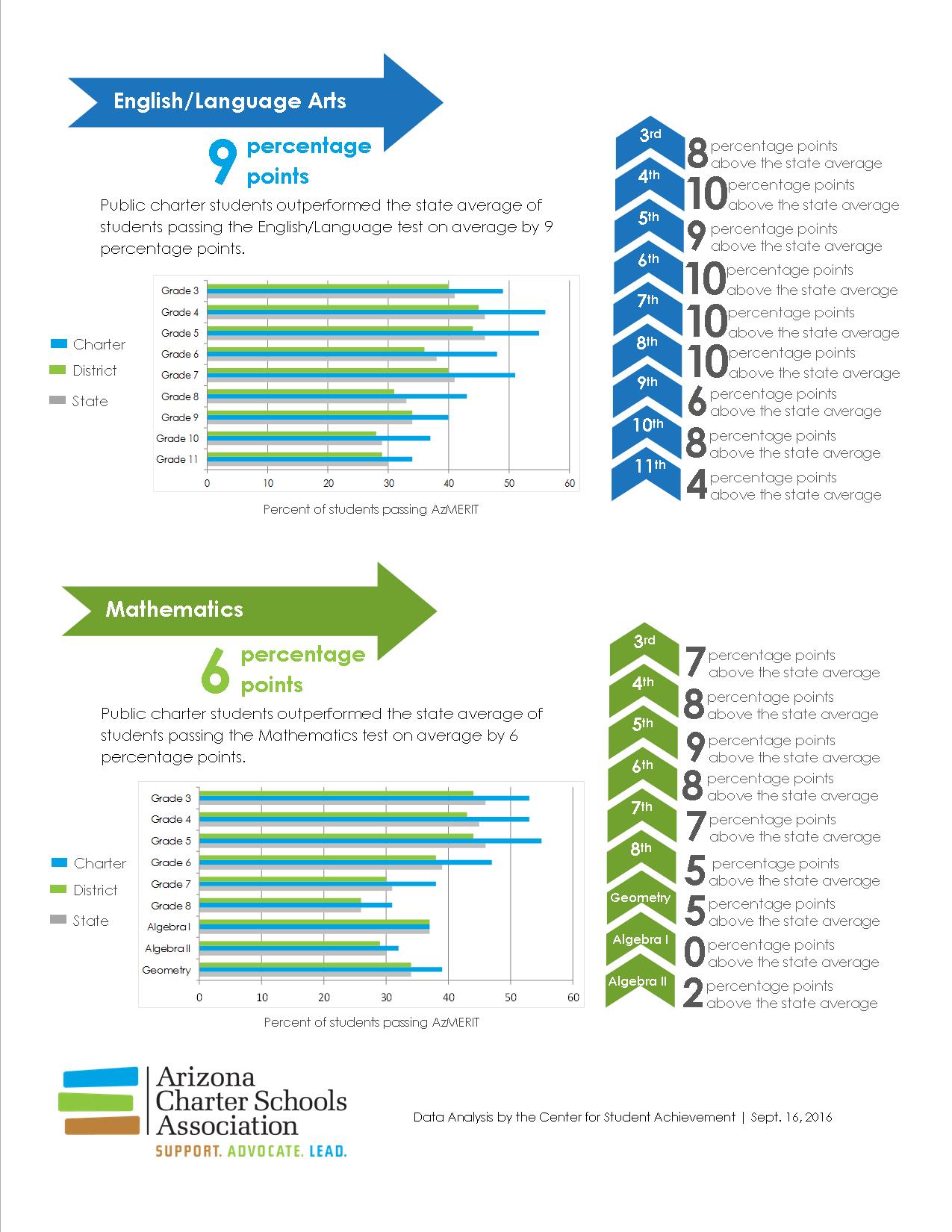
For the second straight year, Arizona charter students outperformed their peers across the state. According to AzMERIT scores released this week, charter students scored better than the state average in the ELA and Math assessment in every grade level and subject area except Algebra I, where charter students tied the state average.

The AzMERIT scores, released by the Arizona Department of Education on September 15, show the hard work and dedication of Arizona’s charter students, teachers and leaders.

“I’m proud to see Arizona’s charter school students continuing to set a strong example of educational excellence. For the second straight year, charter students outperformed the state average in virtually every grade level and subject,” said Eileen Sigmund, President and CEO of the Arizona Charter Schools Association. “While more work remains, these scores are strong validation of the hard work and dedication of our students, teachers and leaders. We’re moving in the right direction, and we’re getting results.”

AzMERIT Charter Highlights

  • Public charter students outperformed the state average of students passing the English/Language test on average by 9 percentage points.
  • Public charter students outperformed the state average of students passing the Mathematics test on average by 6 percentage points.
  • All 50 of the top LEAs on the English/Language Arts exam are charter schools, when looking at percent of students passing the test.
  • 49 of the 50 top LEAs on the Math exams are charters, when looking at percent of students passing the test.

NAEP “The Nation’s Report Card”

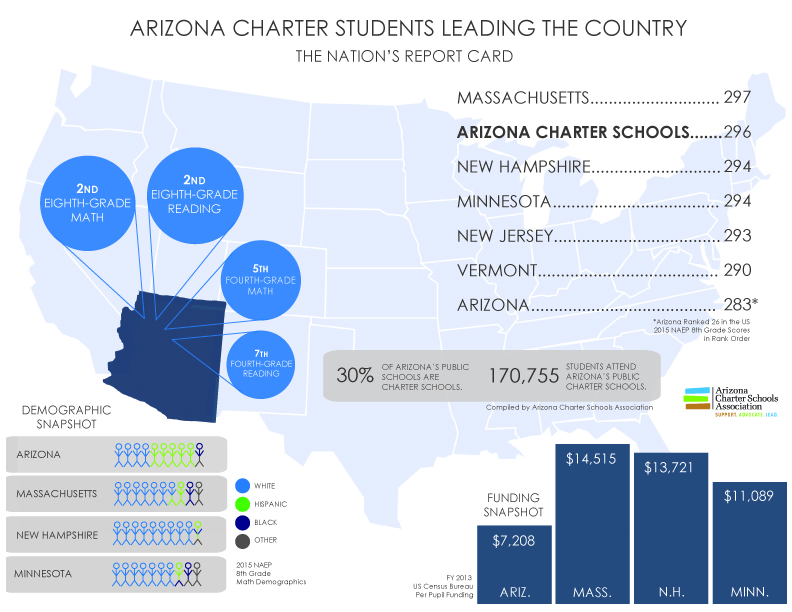
Arizona’s charter students outperformed nearly every other state on the 2015 National Assessment of Educational Progress. On eighth grade mathematics, for instance, Arizona charter students scored in a statistical dead heat with Massachusetts, the highest scoring of the 50 states.

NAEP Infographic
Download our fact sheet here. You can view our 2015 results here.

NET GAINS – CHARTER GROWTH WITHIN SCHOOL DISTRICT BOUNDARIES, PART I

Where has Arizona’s charter school movement grown in the last decade? We found that Tucson Unified School District saw the most new charter schools within its borders, gaining 19while Queen Creek Unified School District gained the most charter students, increasing by 5,286[1].

In Part 1 of our series, we analyzed the net gain of charter schools and students within school district boundaries from FY06 to FY15. In a previous blog we examined overall state attendance trends at the county level.

CHARTER SCHOOL GROWTH WITHIN DISTRICT BOUNDARIES

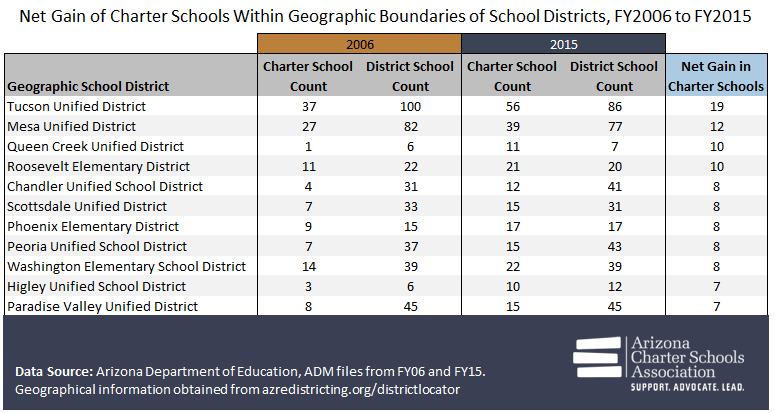
Figure 1 shows school districts that have had the greatest net gain of charter schools within their geographic boundaries from 2006 to 2015[2]. “Net gain” in charter schools is just that – the difference in number of charter schools within a district’s boundaries in 2006 and 2015. It is possible that any number of schools could have actually opened or closed in the years between these two snapshots in time, but in this blog we focus on the net change in the number of schools within a district attendance area.

FIGURE 1: GEOGRAPHIC SCHOOL DISTRICTS WITH LARGEST NET GAIN IN CHARTER SCHOOLS, FY06 TO FY15

Most of the net growth of charter schools has been focused in school districts surrounding Phoenix and Tucson, with Tucson Unified leading the state. Large districts in the northern and southwestern parts of the state have also seen modest net gains in charter schools within their boundaries, namely Yuma Elementary District (2), Flagstaff Unified District (2), Camp Verde Unified District (2), Humboldt Unified District (3) and Prescott Unified District (3).

Perhaps more intuitive and interesting than the table in Figure 1, though, is a look at how the net gain numbers have actually played out throughout the landscape of the state. Taking a closer look at the Phoenix area, we can examine which Valley communities have seen the greatest gains in charter schools. Mesa Unified leads the way in the Valley, gaining 12 charters from 2006 to 2015, while Queen Creek and Roosevelt had a net gain of 10 each.

The interactive map below shows charter school net gain by school district. School districts with a net change of 0 have been excluded. Click on the markers to see the district’s net gain in charter schools.

MAP 1: NET GAIN IN CHARTER SCHOOLS BY SCHOOL DISTRICT, FY06 TO FY15

CHARTER STUDENT GROWTH WITHIN DISTRICT BOUNDARIES

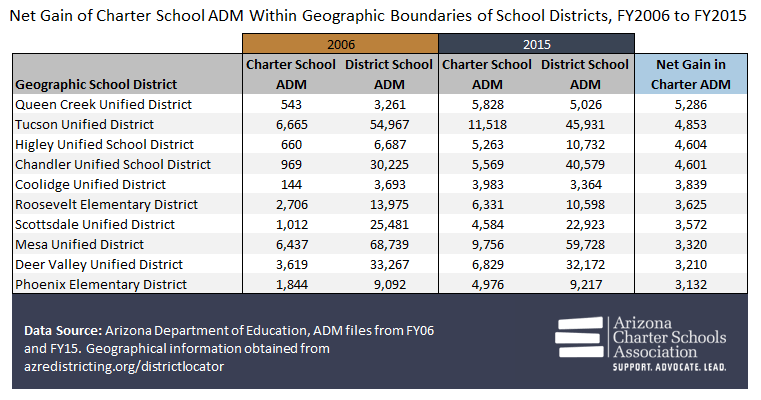
In a related but slightly different question, the Association also looked at absolute net change in charter school attendance, rather than number of charter schools. Figure 2 shows the top ten school districts for net charter average daily membership (ADM) gain between 2006 and 2015:

FIGURE 2: GEOGRAPHIC SCHOOL DISTRICTS WITH LARGEST NET GAIN IN CHARTER SCHOOL ADM, FY06 TO FY15

Tucson Unified is still near the top of the list, however, cedes its number one spot to Queen Creek Unified when the question is viewed through the lens of total students rather than schools. Notably, the two districts that appear in Figure 2 that do not appear in Figure 1 are Coolidge Unified District and Deer Valley Unified District. This suggests that these two districts either added a small number of larger charter schools within their boundaries, or saw strong growth rates within the existing charter schools from 2006.

Again, to see how total charter attendance has changed the educational landscape of the state, the Association mapped the net gain or loss of charter students within all school districts. The picture was similar to that of charter school net gain. Click on the markers to see the district’s net gain or less of charter students.

MAP 2: NET GAIN OR LOSS IN CHARTER STUDENTS BY SCHOOL DISTRICT, FY06 TO FY15

Focusing on the Phoenix area’s overall net change in charter student enrollment, we see similar patterns that reflect the number of charter schools gained within each district’s geographic boundaries. Queen Creek Unified, Higley Unified and Chandler Unified are represented by blue dots on the southeast side of the Valley, while districts like Deer Valley Unified and Peoria Unified can be seen on the northwest end.

SCHOOL IMPLICATIONS

Just as the past decade of overall K-12 growth in Arizona paints a misleading picture of certain counties with declining enrollment trends, the growth of charter schools and students over the past decade should be understood at a finer level than simply the evaluation of statewide trends. As our state grows in population, the growth of our public schools should meet the needs of families. Policy makers should consider enrollment trends, geography, demographics, and community needs in making K-12 policy decisions.

In our next blog, the Association will take a closer look at the charter landscape within districts. In it we will evaluate charter student market share within traditional school district attendance boundaries. This analysis will highlight those districts that are saturated based on the number of schools as well as the number of charter students and how these districts have changed over time.

FOOTNOTES/REFERENCES

[1] This blog is part one of a larger series which will focus on Average Daily Membership trends and snapshots as they relate to the geographic boundaries of a school district. This blog will primarily focus on total gains (“absolute” terms), rather than consider the increases in terms of a percentage of existing ADM or existing number of schools (“relative” terms).

[2] Schools that do not serve students in a typical fashion in a geographical location have been excluded.  In the case of district schools, the Association used state ADM data gathered at the school and district level. In the case of charter schools, the Association gathered geographical information for all charter schools that are currently open, and assigned them to a geographical school district. For certain types of schools that do not have a geographical location listed with ADE, or whose ADM trends are outside the scope of this blog, data were excluded (such as select online schools, JTEDs, accommodation/transportation schools and select BIA schools). Also, there were 11 total charter schools that existed in FY06 but not in FY15, and these were excluded from the geographical analysis.

Additional Note: The Association also created printer-friendly maps that give an overview of which school districts in the state have seen the most charter school growth within their boundaries. Download our PDF of charter growth in school districts HERE.

Categories
Association Blog

The Real Story on Public School Funding

How much money do public schools receive to educate students?

In the last two decades, a significant, although narrowing funding gap has persisted between school district and charter schools.

X