Categories
Press Releases

Arizona Charter Students Top Nation’s Report Card in Science

Arizona charter school students registered substantial gains on the 2015 National Assessment of Educational Progress science assessment, and results show charter students significantly outperforming district peers across the state.

For the fourth-grade NAEP exam, scores for Arizona charter students increased an astounding 21 points since the last time the test was given in 2009; scores among eighth-grade charter students increased 18 points.

“Arizona’s charter model continues to set a national example of excellence,” said Eileen B. Sigmund, Arizona Charter Schools Association President and CEO. “Strong science education is vitally important for the future of our country and our economy. These results are a direct response to the excellent teachers and leaders supporting Arizona’s charter students.”

For the sake of comparison, if Arizona charter students were isolated and measured as their own state, their scores on the 2015 NAEP science test would rank among the top states in the country. On the eighth-grade science test, Arizona charter students would rank as the fourth highest-scoring state nationally, trailing only Utah, New Hampshire and Vermont. For fourth-grade science, Arizona charter students would rank eighth in the country.

Categories
Association Blog Charters Changing Lives

Sun Valley’s Story

How a Mesa Charter School Renewed the Hope in its Students’ Lives

While some say Sun Valley High School is a place for “bad kids,” the real story of the school and its students is one of revived hope.

It’s a place where students who were once on the verge of dropping out are now making the honor roll and joining the National Honor Society.

It’s a place where students who were once bullied for their appearance and lifestyle have now found acceptance, gained confidence and overcame anxiety.

Many of these students have been cast aside as they struggled with homelessness, teen parenthood, adjudication, working to support their families or just not being able to adjust to a traditional large high school.

But they’ve now found teachers and staff at their East Valley charter school who push them to succeed, show genuine concern for their lives, and accept all students, no matter their circumstance.

Categories
Association Blog

Richelle Lewis

Richelle Lewis’ approach to teaching at American Leadership Academy-Queen Creek Elementary extends beyond curriculums, lesson plans and even the classroom.

Lewis, a third-grade teacher, takes a personal approach to her students’ learning, which includes regularly attending events outside of school, such as their baseball games and baptisms, to show encouragement.

Inside the classroom, she relies on data, goal-setting, individualized learning and student engagement, combined with positive reinforcement, personal examples from her own life and even love for her students to foster an emotional connection.

As a result, Lewis’ students are consistently high-performing and her indelible impact is evident as many of her former students return to visit.

Lewis’ dedication to her students, their high academic achievement and care for their personal well-being are among the reasons for her selection as the Arizona Charter School Association’s 2016 Teacher of the Year.

Categories
Association Blog

Betsy Rosenmiller

For Betsy Rosenmiller, the worlds of business and art are intertwined.

Rosenmiller is the finance director for Metropolitan Arts Institute in Phoenix, where she oversees all of the school’s budget, vendor contracts, audits, human resources procedures, and compliance with state and federal requirements.

But her passion for the school goes beyond finance. Rosenmiller is an accomplished ceramics artist who has shown her work nationally and internationally, she is also a jeweler and a former art gallery director.

As a result, she views her job at the school as more than inputting numbers on a spreadsheet, signing paperwork or ensuring the school’s audits are complete.

There’s a personal connection on every transaction for Rosenmiller.

Rosenmiller transformed the small charter school’s front office, which serves about 250 students in grades 7-12, after years of constant transition and helped the school regularly achieve perfect audits. Always looking for to put more money in the classroom, Betsy is constantly researching new vendors and improving efficiency.

Her impeccable business office support and her devotion to the students, faculty and the school’s mission have led to her selection as the Arizona Charter School Association’s 2016 Business Leader of the Year.

Categories
Association Blog

Valerie Merrill

It’s not uncommon to see Legacy Traditional School – Gilbert Principal Valerie Merrill sitting on the grass with her students during a football game or spending her Saturday cheering for the school’s cross country team during a meet.

Merrill is probably the most visible people on campus, whether she’s encouraging students at a sporting event, speaking with parents in the front office or working the register in the cafeteria because the cashier is sick.

Her ability to interact with students, teachers, parents and the surrounding community has spurred a culture change at a school that was in need of strong direction, attention and Merrill’s own personal touch.

In two years, Legacy Gilbert has added 300 students, increased parent and teacher satisfaction, and transformed the school into a family friendly place that engages families and the rest of the community.

These dramatic changes have led to Merrill’s selection as the Arizona Charter School Association’s 2016 Transformational Leader of the Year.

Categories
Association Blog

Academy of Math and Science – Prince

Academy of Math and Science-Prince does not let circumstance determine a child’s success in school.

Students at the Tucson K-8 public charter school learn pre-algebra as early as third grade, play either the piano or guitar and take classes in Russian, Mandarin or Spanish.

Uniforms are a requirement and students are quick to give their attention to a teacher or principal who is speaking or giving direction, whether it’s during a class assignment, walking the corridors in between classes or a cafeteria announcement.

Teachers, administrators and staff hold high expectations for their students, but the discipline is mixed with genuine care, concern and what many describe as a family atmosphere.

And it works.

The 2008 National Blue Ribbon School has consistently been rated an ‘A’ school in the state’s accountability system despite the fact that more than 70 percent of its students qualify for free or reduced priced lunch.

For those reasons, AMS Prince was selected as the Arizona Charter School Association’s 2016 Charter School of the Year.

PROPORTIONAL GAINS – CHARTER GROWTH WITHIN SCHOOL DISTRICT BOUNDARIES, PART II

What does the growth of Arizona’s charter school movement mean for local control? School choice (in its broadest definition) decreases the number of voters with an immediate investment in the passage of local taxation questions because these parents no longer have a direct benefit from passing a bond and override in their local school district. Likewise, the parents of students attending a school district via open enrollment cannot vote for a bond and override that will benefit their child directly.

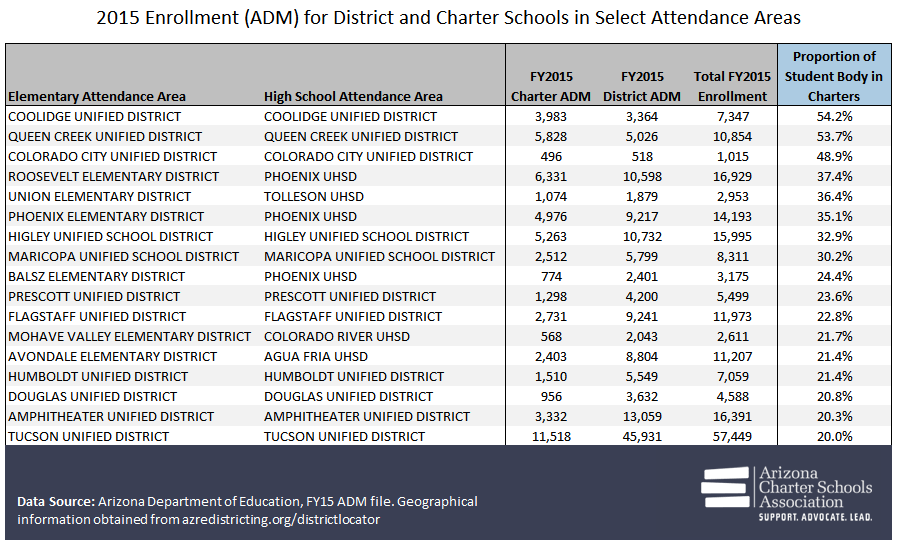
With the continued and steady expansion of charter schools, Arizona now has school districts where the majority of students within district boundaries attend charter schools. Continuing our series on school enrollment trends, in this edition we explore the distribution of students choosing district or charter schools within an attendance area. We found that several district attendance areas now have parity in the population of students attending charter schools and district schools. The Coolidge, Queen Creek and Colorado City School Districts all have seen tremendous charter school growth over the past decade (see our last blog) and now roughly an equal number of students are enrolled in charter schools as district schools within these districts’ boundaries.

FIGURE 1 – 2015 ENROLLMENT (ADM) FOR DISTRICT AND CHARTER SCHOOLS IN SELECT ATTENDANCE AREAS[1]

Figure 1 shows charter and district school enrollment numbers by geographical attendance area (elementary district boundaries in this case). For this analysis, high schools–both district and charter–were mapped to elementary attendance areas because elementary districts provide a more granular frame of reference than high school district boundaries. Where districts do not have a unified system of elementary level and high school level schools, both attendance areas are noted in the table above.

The interactive map below allows us to take a closer look at the Phoenix area, examining which Valley communities have seen the greatest proportional gains in student enrollment in charter schools. The southeast Valley as a region has seen the greatest proportion of student enrollment in charter schools, with Queen Creek and Coolidge School Districts now enrolling less than half of the students attending school in their attendance areas.  That is, these districts no longer contain a majority of students (and their families) who are tied to the local school district governance and decision-making structure.

MAP 1 – PROPORTION OF STUDENTS IN CHARTER SCHOOLS BY ATTENDANCE AREA

(Click on an attendance area in the map above to see the FY2015 details)

IMPLICATIONS

Arizona, like most states, grants households with school-age children a free and appropriate public education based on the district’s boundaries in which the household is located. Additionally, Arizona law allows families the option to attend public schools of their choice (district or charter), so long as seating capacity is available and parents are able to transport their student. Despite this flexibility, school district attendance areas still serve as real and consequential boundaries for political and planning purposes as well as the taxation of households. Though district boundaries and school addresses are fixed locations, families are clearly exercising their freedom of choice within and between attendance areas. These data suggest that significant numbers of families choose to send their students to both charter and neighboring district schools rather than the default of their home’s neighborhood school district.

Why is this finding important?

When the public registers to vote they are asked to participate in governance and taxations issues related to the school district that they are assigned based on the location of their home.  Families choosing charter schools or district schools outside of their home attendance area are not afforded direct say in taxation and governance decisions for the school district or charter where they choose to send their children.  At the same time an increasing number of Arizona families are exercising the proverbial “vote with their feet” with respect to their school of choice, their voting rights are still restricted to their local school district’s elections.  The only exception applies to statewide initiatives, such as Proposition 301 and the recently passed Proposition 123, that are not restricted based on local school district affiliation.

There is a presumption (or at least a common perception) that local district elections provide for strong local control and governance because of the commitment of the voting citizenry which has historically included the voting parents of children who attended their local public schools. These voting parents have been critical to this system as they theoretically had a vested interest in directly supporting their child’s public education.


“Local investment is potentially at jeopardy given these voters no longer have a direct, vested interest in the outcome of elections on their neighborhood schools.”

These data suggest that perhaps this system of local investment is potentially at jeopardy given these voters no longer have a direct, vested interest in the outcome of elections on their neighborhood schools. In other words, school choice (in its broadest definition) decreases the number of voters with an immediate investment in the passage of the bond and override because neither the parents of open enrollment students nor charter schools have a direct benefit from passing the bond and override in their local school district. Likewise, the parents of students attending a school district via open enrollment cannot vote for a bond and override that will benefit their child directly.

It should be noted that the number of students choosing to attend other districts schools through open enrollment is presumed in this blog, and the actual count of students is not reported through existing state data sources.  Anecdotally, some districts report that they receive more than 10 percent of their students from other school districts.  In order to fully understand the impact of the state’s open enrollment statutes on school districts’ total enrollment additional data is necessary.  To date, there is no publicly available information that reports open enrollment numbers or any way to infer this information from available data.

Open enrollment to all schools (charter school and district schools) outside of home attendance areas raises questions about how Arizona citizens can best support, define and participate in the kind of school systems they choose to send their children. The free movement of the Arizona public school student body has implications for our school finance system as well as our role as citizens in the governance of our schools. With the flagging ties to local control of funds and charter schools’ complete dependence on statewide general revenue funds, it seems that reform to the school finance system that funds schools based on school district boundaries and the ability to pass local taxes is warranted.

Footnotes/References

[1] Average Daily Attendance from Arizona Department of Education. Attendance areas for charter schools were assigned using the Arizona District Locator, http://azredistricting.org/districtlocator/

For more on the policy effects of school choice, see The distance between desk and home: the policy and finance implications of school choice policies

 

Categories
Press Releases

Charter Award Winners Announced

As a national leader in the charter movement, Arizona has numerous examples of charter success. The Arizona Charter Schools Association is pleased to honor exemplary educators with our 2016 Charter Awards, which annually recognizes the top charter teacher, leader, business manager and school in Arizona. The award winners highlight some of the best of what Arizona’s charter movement has to offer.

“I’m thrilled to recognize these outstanding recipients of the 2016 Charter Awards, which honor the very best of Arizona’s public charter schools,” said Eileen B. Sigmund, President and CEO of the Arizona Charter Schools Association. “What these winners have in common is their innovative approach to education and committed focus to the success of their students.”

Winners and finalists will be honored at a ceremony on November 2 at the Hotel Palomar.

X