While acknowledging Arizona K-12 funding is low compared to the national average, Governor Ducey in his state of the state provided policymakers 15 points to make Arizona more competitive for our educators and students.
But how low is our per-pupil funding compared to other states? And how long have we ranked near the bottom of the nation? In this month’s blog, the Association compiled historical school funding metrics to evaluate how Arizona stacks up against other states in terms of funding per pupil, pupil-teacher ratios, and school size. In terms of school funding – we won’t mention hair styles – the ‘80s were great. Arizona funded its schools at levels slightly above the national average. Unfortunately, Arizona now is skimming the bottom of the funding barrel. Arizona boasts some of the largest teacher-student ratios while its school sizes near the national average.
Funding Per Pupil
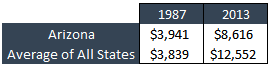
The National Center for Education Statistics reports that in the late 1980s, Arizona funded its public schools at the national state average in terms of per-pupil revenues. But in the 1990s through the 2000s and up until the most recent data available (2013), Arizona slipped to “bad” and then to “worse”, becoming one of the lowest funded public education systems in the country, on a per-pupil basis.
The last complete revamping of Arizona’s school finance system occurred in 1980. At that time, policymakers sought to limit local tax liabilities while “equalizing” funds between school districts to ensure a degree of equity. Besides annual skirmishes regarding school funding at the Legislature, Arizona has litigated the funding formula over inflation, capital improvements and maintenance, and funding our English language learners.
In 1994, Arizona lawmakers established a system of charter schools, separate from school districts and with a completely different school funding system. The narrated video below provides a national look at how states fund students, on a per pupil basis. On the left, a bar graph illustrates the state-by-state differences in funding in absolute dollars. On the right, the same information is displayed, but in map form. Click play to see how funding changes for each state over time, from 1987 to 2013.
For an interactive dashboard of the state-by-state funding per pupil video, click here. The dashboard allows for a more detailed look at each state or each year of the video.
In the final year of the above video (2013), the inter-mountain West (Arizona, Utah and Idaho) settled in as the lowest public school funding in terms of per-pupil dollars. Though Arizonans passed a number of funding initiatives (Proposition 301 in 2000, Proposition 123 in 2016 and scores of local district bonds and budget overrides), the per pupil downward slide continued.
Pupil-Teacher Ratios
Teachers and teaching staff are the largest expenditure in Arizona’s school system. Not surprisingly, Arizona and other states in the bottom quarter of per-pupil revenue distribution tend to have larger class sizes.
In the narrated animation below, state per-pupil funding is plotted against student-teacher ratios for all states, and tracked over time. From these data, it is unclear how the rumored impending teacher shortage crisis plays out as a cause or a symptom of relatively large class sizes and low revenues. As of 2013, the western states of Utah, Arizona, Nevada, California, Washington, and Oregon had established themselves as a cohort of states having the highest pupil-to-teacher ratios, and some of the lowest per-pupil funding.
Average School Size
Arizona has been above average in the number of students per school site over the years. Though the national average school size has shrunk, Arizona is still above the national average. Given the state’s funding mechanism, historical interests for smaller learning communities and Arizona’s robust school choice movement, it is not surprising that extremely large schools, with relatively low per-pupil administrative costs, have not manifested. In fact, Arizona’s school sizes were larger before Arizona allowed charter schools in 1994. As charters grew in number, Arizona average school sizes have shrunk incrementally, nearing the national average.
Despite this trend, in 2015, Arizona lawmakers voted to eliminate “small school weights” for charter schools that are part of a network , even if the schools are located far apart. Arizona is scheduled to completely eliminate small school weight funding for charter schools during this legislative session.
For an interactive dashboard of the average school size video, click here. The dashboard allows for a more detailed look at each state or each year of the video.
Conclusion
Arizona wasn’t always competing for last place in terms of school funding. As recently as the 1980s, Arizona spent at the national average per pupil. In less than thirty years, Arizona’s relative ranking has dropped by double-digits, despite more than doubling the state’s per pupil allocation to schools. Failure to keep up with the national trends in school funding has serious consequences for Arizona’s education system. First, Arizona has some of the highest student-teacher ratios compared to other neighboring states. Second, Arizona’s school sizes are shrinking closer to the national average. This meeting in the middle means that, on average, Arizona’s schools are cramming more students into classrooms to maximize the resources that the schools receive. It is unclear how long Arizona’s education system can keep this up.



 Charter teachers have played a prominent role in these presentations, with Rep. Paul Boyer, chairman of the House Committee on Education, working with the Association to bring some of the best charter educators to the legislature.
 “Ms. DeVos is a proven leader who will fight for education reform that works – just as she has done for nearly three decades. That means putting students over special interests, expanding access to high-performing schools, empowering parents and loosening the federal government’s grip on education policy decisions that are better left to local officials.