
Categories
Education Blog

IDEA Funding

Part B Special Education Funding for Charter Schools

In 2014, the Association began investigating IDEA Part B funding for special education students after several charter schools raised concerns. Based on our research, 268 LEAs — district and charter — did not receive IDEA Part B Basic funding for their special education population, because according to the 1998 census they had no special education students.

Based on member feedback, we provided a webinar to help our schools understand how to get access to the Charter School Expansion Act (CSEA) grant, which is intended to address special education enrollment discrepancies

The IDEA Part B grant provides additional federal support for students based on a formula that considers the school’s 1) special education student enrollment, based on the 1998 Census, 2) the percent of the state’s poverty and 3) the percent of the state’s population. In this formula, the school’s special education enrollment receives the greatest funding at $513 per student; whereas the percentage of students in poverty and percentage of the population are funded at $29 and $91, respectively.

Charter schools that opened after 1998 or have experienced a significant increase in their special education enrollment are eligible to submit data to the Department through the Charter School Expansion Act (CSEA) grant. This grant is intended to address special education student enrollment discrepancies. Based on our research and findings, it is clear that charter schools need additional training and support regarding the CSEA and its ongoing use to make sure that they are receiving full funding for their special education students. This lack of training and support has resulted in significant underfunding to schools.

The Association used the 2015 IDEA Basic Entitlement data available online and merged estimated special education enrollment data from the AIMS testing file to determine the impact of special education students that are unaccounted for. This method is likely to result in a lower than expected number for each school because the AIMS data file only includes FAY special education students. Special education students in grades K-2, 9, 11 and 12 who aren’t retesting are excluded from this data. Regardless, this methodology resulted in 268 LEAs, district and charter, that did not receive IDEA Part B Basic funding for their special education population, because according to the 1998 census they had no special education students.

Therefore, these schools are only receiving IDEA Part B Basic funding for their percentage of state poverty and percentage of state population. Since each special education students’ (from the 1998 census) base level support is $513, these schools are being underfunded significantly. The total underfunding for these LEAs from IDEA Part B is $2,242,639.52. The true results, even given the likely underestimation, are staggering.
Arizona Charter School Leads the Way in U.S. News and World Report Medal Rankings

Once again, an Arizona charter school topped a prominent national ranking. U.S. News and World Report ranked BASIS Scottsdale first on its list of Arizona “Gold” schools. There were six schools on the list, including BASIS and two other charter schools.

Categories
Education Blog

What About Poverty? Food for Thought on the Classroom Spending Debate

Educating children often requires much more than quality instruction; most educators agree on the need to offer services that meet students’ social, emotional, and material needs if students are to succeed in the classroom[1]. Depending on the school, grade level, and student demographics, these additional needs can take the form of school counselors, social workers, before and after school programs, or parent outreach. Such services have been a part of the recent discussion around classroom vs. non-classroom spending.

Missing from the conversations about spending is an acknowledgement of the percentage of students in Arizona public schools who are living in poverty and as a result are more likely to need and benefit from “non-classroom” services.  In the coming year, schools will likely face further reductions in budgets and increased pressure to “put more money in the classroom.”  In order to provide some context and insight into the challenges facing Arizona public schools, the Association feels that it is beneficial to examine statewide trends in student poverty[2].

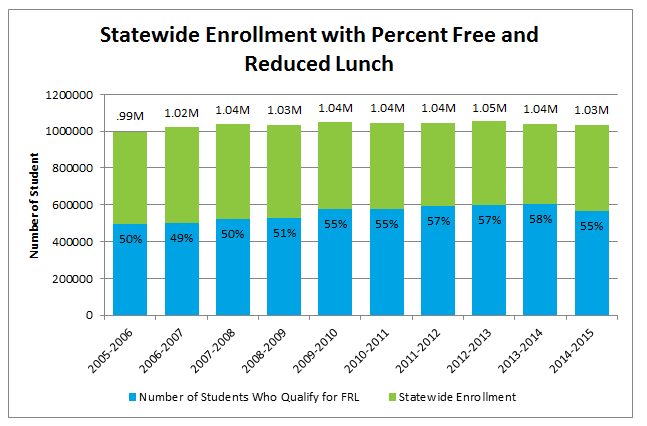
The graph presents statewide student enrollment in Arizona’s public schools and the number of students who qualified for free and reduced price lunch during the past 10 years[3].  As the graph shows, overall enrollment in Arizona public schools has fluctuated at just over one million students during this time. In comparison, the data indicate a steady increase in the percent of students eligible for free and reduced price lunch from 2007-2008 through 2013-14. In the most recent year, there is a slight decrease (-3%) reported.

The slight decrease in poverty in 2014-2015 may be an indicator of economic recovery and if it continues one would expect a decrease in the demand for student supports in schools as fewer families live in poverty.  All other school spending being equal, one would expect a corresponding increase in the percent of funding that goes to the classroom.

The relationship between poverty and the percent of funding that goes inside or outside of the classroom is a research and policy question worth pursuing. The insights gained from this research can help policymakers understand the larger economic dynamics at work in Arizona’s public schools.  These data may be useful in determining whether the percent of dollars spent outside of the classroom is a reflection of inefficiencies in the system, as it is often portrayed, or a reflection of the level of need in the student population.  The Association believes that these data are important for policy makers to consider as they begin to better understand the context of school level expenditures.
Footnotes
[1] Moore, K.A., & Emig, C. (2014). Integrated student supports: A summary of the evidence base for policymakers. Bathesda, MD: Child Trends.  Retrieved on 5/1/15 from http://www.childtrends.org/wp-content/uploads/2014/02/2014-05ISSWhitePaper3.pdf.
[2] Data for this analysis were taken from the “Average Daily Membership” (ADM) and “Percentage of Children Approved for Free or Reduced-Price Lunches” files made publicly available by the Arizona Department of Education.
[3] We acknowledge that eligibility for free and reduced price lunch is a proxy indicator of poverty and that there are limitations to its usefulness. Schools that do not participate in the National School Lunch Program do not have FRL data and there are a number of reasons why schools may not participate in the program.  However, this does not mean that these schools do not enroll poor children.  As a result, the numbers reported by the state should be considered conservative estimates.

Association President Discusses Biggest Challenges Facing Arizona Schools

[pexyoutube pex_attr_src=”https://www.youtube.com/watch?v=TSYM5tkfP_M”][/pexyoutube]

Arizona Charter Schools Association President Eileen Sigmund appeared on Fox 10’s Newsmaker Sunday to discuss the biggest hurdles facing Arizona schools.

X